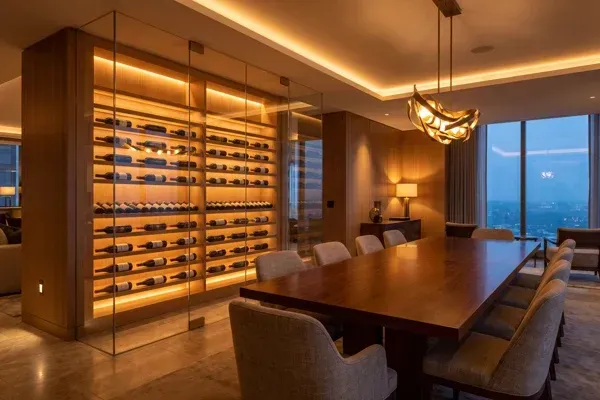
Wine Room Design: Where Display Meets Proper Storage
By Martha Huk, Principal Designer and Project Lead - Last updated August 2026
A wine wall photographs beautifully. That’s exactly the problem. Wine room design sits at the intersection of two jobs that pull against each other: displaying bottles like objects and storing them like perishables. Get the balance wrong, and the prettiest feature in the house slowly damages everything inside it.
This guide covers both halves. You’ll learn the conditions wine actually needs, when a wine wall beats a dedicated wine room, how to keep glass enclosures from overheating, and where each belongs in a luxury floor plan.
Key Takeaways
- Wine keeps best between 45 and 65 degrees Fahrenheit, with 55 often cited as close to perfect, at around 70 percent humidity (Wine Spectator).
- A wine wall is display-first and a wine room is storage-first. The strongest designs decide that ratio deliberately.
- Heat, UV light, and temperature swings are the three ways a beautiful display hurts wine, and all three get solved in design, not after move-in.
- Conditioning is a mechanical scope with real electrical and drainage requirements. It belongs in the construction drawings, not the decor budget.
What Is a Wine Room, and How Is It Different From a Cellar?
A wine room is a purpose-built, climate-controlled space for storing and showing wine on a living level of the house. A traditional cellar borrows cool, stable conditions from sitting below grade. A wine wall compresses the same function into a glazed display, often a single bottle deep. What the wine needs never changes; only the architecture around it does.
The shift from basement cellar to main-floor wine room tracks how luxury homes entertain now. Owners want to pour in front of guests, not disappear down a stair mid-dinner. The same logic that drives a dedicated home theater applies here: the space earns its footprint by doing one job properly.
So which format is right for your house? A collector protecting two thousand bottles has a storage problem with a display component. An entertainer with two hundred favorites has the reverse. The two briefs produce different rooms.
What Conditions Does Wine Actually Need?
Long-term storage calls for 45 to 65 degrees Fahrenheit, with 55 widely cited as close to perfect, at roughly 70 percent relative humidity (Wine Spectator). The Australian Wine Research Institute likewise recommends cool storage at 15 to 20 degrees Celsius, about 59 to 68 Fahrenheit (AWRI).
Stability matters more than the setpoint. Wine Spectator’s guidance is blunt: avoiding rapid, extreme, or frequent swings matters more than a perfect 55, because expansion and contraction of the liquid can push the cork or cause seepage. The AWRI makes the same point, warning that thermal cycling between day and night temperatures should be avoided, and that storage above 25 degrees Celsius (77 Fahrenheit) for long periods affects quality.
Anywhere from 50 to 80 percent humidity is considered safe, with 70 the conventional target; a dried-out cork can compromise its seal and prematurely age the wine. Sunlight is its own hazard: UV rays degrade and prematurely age wine, and even household bulbs will fade labels over time (Wine Spectator).
| Factor | Target | Acceptable range | Why it matters |
|---|---|---|---|
| Temperature | About 55 F | 45-65 F | Above 70 F, wine ages faster than is usually desirable |
| Stability | Steady year-round | Slow seasonal drift only | Swings expand and contract the wine, stressing the cork |
| Humidity | About 70% | 50-80% | Dry corks shrink and let air reach the wine |
| Light | Low, UV-filtered | No direct sun | UV degrades wine; bright light fades labels |
| Vibration | Minimal | Isolated from equipment | Suspected of speeding chemical reactions over time |
| Bottle position | Horizontal for cork | Upright fine for screwcap | Keeps the cork in contact with the wine |
Sources: Wine Spectator storage guidance and AWRI storage notes.
Wine Wall or Wine Room: Which One Fits Your Home?
A wine wall suits collections up to a few hundred bottles where entertaining comes first. A wine room suits serious collections that need capacity, organization, and tightly held conditions. Many clients end up wanting some of both: a conditioned room that carries the collection, and a glazed wall where guests actually see it.
| Wine wall | Wine room | |
|---|---|---|
| Primary job | Display | Storage plus display |
| Typical capacity | Dozens to a few hundred bottles | Several hundred to several thousand |
| Where it lives | Dining room, great room, transition spaces | Lower level or a dedicated interior room |
| Conditioning | Cooling behind sealed glazing | Dedicated cooling inside a vapor-sealed envelope |
| Racking | Single-deep, label-forward | Display rows up front, bulk storage behind |
| Best for | The entertainer | The collector |
Our renderings show the display side of this decision. The Hillside Palisades set includes a wine wall, and the Solara set includes a wine display of its own.
Want to see how each reads in a complete scheme? The portfolio gallery filters 146 renderings across twelve projects by room.
How Do You Keep a Glass Wine Wall From Cooking the Wine?
With insulated glazing, sealed doors, low-heat lighting, and cooling sized for the glass. Glass is the worst insulator in the room, which means the feature everyone loves is also the biggest thermal liability. A wine wall that ignores this becomes a warm, brightly lit showcase for slowly spoiling bottles.
The glazing spec does the heavy lifting. Insulated, low-e units in thermally improved frames slow heat gain, and gasketed doors keep the cooled air where it belongs. A single-pane frameless enclosure looks minimal, but it forces the cooling equipment to fight the whole house all day, and that fight shows up as noise, condensation, and energy use.
Lighting deserves the same scrutiny. LED sources run cool and can graze labels rather than flood bottles. Since UV exposure degrades wine, the goal is glow, not daylight. Why do so many builder-grade wine walls fail? Because they were specified as millwork with a fridge attached, not as a small refrigerated room that happens to be beautiful.
The Mechanical Scope: Cooling, Vapor, and Condensation
A conditioned wine space is a small refrigeration envelope inside the house. That means a dedicated cooling unit, an insulated and vapor-sealed enclosure, power, and somewhere for condensate to go. None of that is decor. It’s mechanical, electrical, and plumbing scope that belongs in the documents from day one.
“A wine wall is a small refrigeration problem wearing a jewelry box. Solve the physics first, and the beauty holds up for decades.”
- Martha Huk, Principal Designer and Project Lead
Cooling equipment comes in three broad families: self-contained through-wall units, split systems with a remote condenser, and ducted systems that hide the equipment entirely. Each rejects heat somewhere, makes noise, and needs service access. The choice changes the framing, the electrical plan, and sometimes the roof plan. Decide it late and you pay for it twice.
This is exactly the coordination problem construction drawings exist to solve. As a design-build practice, we carry the wine room from concept through construction as one scope, working alongside your licensed professionals on the mechanical and electrical trades. That’s the design-build model at work: nobody referees between the millworker, the glazing sub, and the HVAC contractor, because one team owns the interface.
Where Should the Wine Room Go in the Floor Plan?
Close to where you entertain, away from heat and direct sun. Dining-adjacent interior walls, butler’s pantry zones, stair landings, and lower levels all work well. Two questions decide it: how far does a bottle travel during a dinner party, and what’s on the other side of the wall?
Keep the enclosure on interior walls, away from south- and west-facing glass, kitchen appliance walls, and mechanical rooms, which add heat and vibration. Lower levels remain the easy win for larger collections; the ground does part of the conditioning work for free.
Timing matters as much as placement. In a new build, the volume gets reserved early in the custom home design process, when moving a wall costs nothing. In a whole-home renovation, under-stair volumes, oversized closets, and pantry conversions are the usual candidates, and our residential design work often folds the wine feature into a larger rework of the entertaining spaces. If summer hosting moves outside, siting the room on the axis toward the outdoor living areas keeps service lines short.
Racking, Capacity, and the Display-to-Storage Ratio
Start with an honest count of what you own, then plan for growth. Racking design follows the same discipline as a well-planned dressing room: measure the actual inventory, decide what deserves display, and give the rest efficient bulk storage. A collection that fits the room on move-in day is a room that’s already too small.
Cork-sealed bottles store horizontally so the wine keeps the cork wet and the seal stays tight. Label-forward display rows angle bottles toward the viewer and cost capacity; double-deep and case storage carry the volume invisibly. A common split reserves the glazed, eye-level real estate for a tenth of the collection and lets dense racking do the quiet work behind it.
Material choice is mostly aesthetic. Metal pegs read modern and let the bottles carry the composition; wood racking reads classic and warms the room. Large formats and odd Champagne shoulders need dedicated slots, so flag them before the racking is drawn.
See Wine Storage Designed In, Not Bolted On
Hedgeford & Berkley has been designing and building since 2015, and the portfolio spans twelve projects documented in 146 renderings, wine displays among them. Browse the full gallery, filter by room, and see how wine walls sit inside whole compositions. If you’re planning a home around a collection, tell us about the project and we’ll talk through what the physics and the floor plan will support.
Frequently Asked Questions
What temperature should a wine room be kept at?
Between 45 and 65 degrees Fahrenheit, with 55 often cited as close to perfect (Wine Spectator). Stability beats precision: rapid or frequent swings expand and contract the wine and stress the cork. Design the enclosure and cooling to hold steady through every season, not to chase one perfect reading.
How much humidity does a wine room need?
About 70 percent relative humidity is the conventional target, and anywhere between 50 and 80 percent is considered safe (Wine Spectator). Run too dry and corks shrink, letting air reach the wine. Run too damp and labels and millwork suffer. The wine cooling system, not the household HVAC, should own this number.
Do glass wine walls damage wine?
Not when they’re specified properly. Glass sheds conditioned air quickly and admits light, and UV in particular degrades and prematurely ages wine (Wine Spectator). Insulated low-e glazing, gasketed doors, cool-running LED lighting, and a cooling unit sized for the glass keep a display wall genuinely storage-grade.
Can you put a wine wall in a dining room?
Yes, and it’s one of the most natural placements, provided the wall is built as its own sealed, conditioned envelope. Favor interior walls away from direct sun and heat-producing appliances. Our Hillside Palisades and Solara projects both include wine displays among their renderings.
Do wine bottles really need to be stored on their sides?
Cork-sealed bottles do. The Australian Wine Research Institute recommends storing bottled wine with the cork in contact with the wine, in a cool, dry location (AWRI). A wet cork holds its seal. Screwcap bottles can stand upright, which is one reason display shelving mixes orientations freely.
The Short Version
Wine room design succeeds when the storage physics and the display ambition get resolved in the same set of drawings. Hold 45 to 65 degrees steadily, keep humidity near 70 percent, filter the light, seal the envelope, and give the equipment a real home. Then, and only then, make it gorgeous.
Decide the display-to-storage ratio deliberately, place the room where entertaining actually happens, and lock the mechanical scope in early. The next step is seeing how those decisions flow through a project: our process walks through it, from first concept to construction-ready documentation.
Martha Huk is the Principal Designer and Project Lead at Hedgeford & Berkley, the design-build practice she founded in 2015. She worked as a design engineer at General Dynamics Land Systems specializing in thermal and fluid dynamics, and renovated homes for over a decade before combining the two backgrounds into one firm. Her work pairs construction-ready documentation with a designer’s eye for the details that make a home worth living in.